
Concentrations
Upon admission, students must select one of the following concentrations:
① Finance/Risk Management ② Accounting ③ Marketing ④ OBHRM·Strategy ⑤ LSOM ⑥ Digital Intelligence ⑦ Business Analytics ⑧ International Business
Note: An application to change your academic advisor may be submitted only once.
Courses and Credits
Master of Business Administration (MS) Program

| Category | Course Details | Credits |
|---|---|---|
| Basic Required Courses | Statistical Analysis Methodology, Research Methodology, Data Mining and Decision Making, Modern Applied Statistics, Time Series Analysis and Forecasting, IT Research Methodology, Business Data Analysis using Text Mining, Multivariate Analysis (Research), Microeconomics, Econometrics, Advanced Psychological Statistics, Understanding and Application of Multilevel Modeling, Qualitative Research Methods | 6 Credits (2 Courses) |
| Common Required Courses (Select 2) |
Financial Accounting, Management & Organizations (or Human Resource Management & Organizational Behavior), Strategic Management, Financial Management (or Finance), Operations Management, International Business, Management Information Systems, Decision Making, Risk and Insurance, Understanding and Application of Multilevel Modeling, Qualitative Research Methods, Consumer Behavior (Effective from 2022 academic year) | 6 Credits (2 Courses) |
| Major Electives | 12 Credits | |
| Special Research | 3 Credits | |
| Graduation Thesis | 0 Credits | |
| Total Credits Required | 27 Credits or more | |
- Before registering for courses each semester, students must complete a [Course Registration Form] and obtain approval from the Director of the Graduate Program in their respective concentration. Once an academic advisor is assigned, students must obtain approval from both the Director and their academic advisor. With the approval of the Director, students may substitute up to 6 credits of Major Electives with General Electives .
- Special Research can be taken starting from the third semester. Students receive specialized guidance for thesis writing under the supervision of their academic advisor. Within the minimum requirement of 27 total credits for graduation, a maximum of 3 credits are recognized for Special Research.
Doctor of Philosophy (Ph.D.) in Business Administration
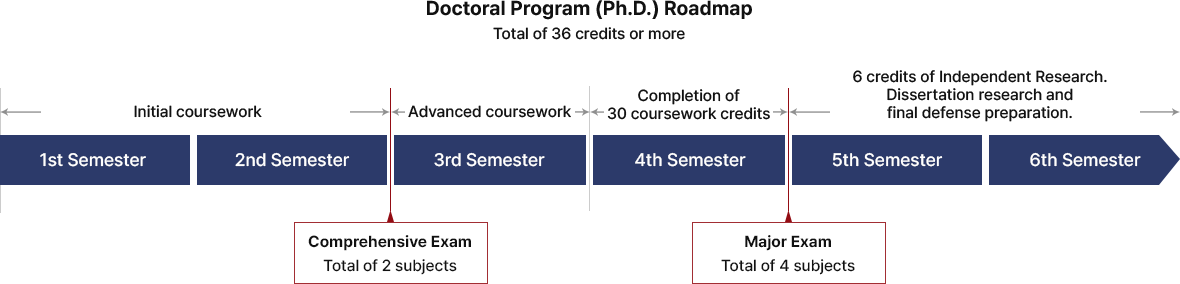
| Category | Course Details | Credits |
|---|---|---|
| Basic Required Courses | Statistical Analysis Methodology, Research Methodology, Data Mining and Decision Making, Modern Applied Statistics, Time Series Analysis and Forecasting, IT Research Methodology, Business Data Analysis using Text Mining, Multivariate Analysis (Research), Microeconomics, Econometrics, Advanced Psychological Statistics, Understanding and Application of Multilevel Modeling, Qualitative Research Methods | 9 Credits (3 Courses) |
| Major Electives | Courses selected within the student's chosen concentration | 15 Credits or more |
| Independent Research (3 Credits per course) | Eligible for registration starting from the semester after passing the Major Field Exam; a maximum of 3 credits per semester can be earned | 6 Credits or more |
| Electives Outside Major | Courses outside of the student's primary major concentration | 6 Credits or more |
| Graduation Dissertation | 0 Credits | |
| Total Credits Required | 36 Credits or more | |
- Before registering for courses each semester, students must complete a [Course Registration Form] and obtain approval from the Director of the Graduate Program in their respective concentration. Once an academic advisor is assigned, students must obtain approval from both the Director and their academic advisor.
- With the approval of the Director, students may earn up to 12 credits from other graduate schools within Sogang University or at other universities. However, for Major Electives, a maximum of only 9 credits can be recognized. Up to 6 credits from MBA courses may be accepted, but these will be counted as Electives Outside Major.
- Independent Research can be taken starting from the semester after passing all sections of the Major Field Exam. A maximum of 3 credits may be taken per semester. Students receive specialized guidance for dissertation writing under the supervision of their academic advisor.
Qualification Exams
Comprehensive Exam
Passing the Comprehensive Exam is mandatory for obtaining both Master’s and Doctoral degrees. A score of 70 points or higher per subject is required to pass.
- Master’s (MS): Students may apply for the exam for two Basic Required Courses starting from the end of their second semester. The exam is administered at the end of each semester. In case of failure, students may apply for one additional retake per subject.
- Doctoral (Ph.D.): Students select two out of the three Basic Required Courses they have completed. As a rule, the exam should be taken after the second semester and before the start of the third semester. Two retakes are permitted, and partial retakes for individual subjects are allowed.
Major Field Exam (Ph.D. Only)
- Passing the Major Field Exam is required for the Doctoral degree. Students select four Major Elective courses to be tested on. As a rule, the exam is taken after the fourth semester and before the start of the fifth semester. A score of 70 points or higher per subject is required to pass. Two retakes are permitted, and partial retakes for individual subjects are allowed.
Proof of Foreign Language Proficiency
In accordance with University Statutes and enforcement regulations, all MS and Ph.D. students must submit proof of foreign language proficiency.
- Campus Exam: A score of 60 or higher out of 100 on the internal foreign language exam administered by the Graduate School.
- Students may be exempt from the exam by submitting valid external test scores along with a "Foreign Language Exam Waiver Form."
*For detailed criteria, please refer to the "Foreign Language Exam Guide" under the Academic/Class/Graduation section of the Graduate School website.
Thesis Defense
- To obtain a degree, students must complete Special Research (MS) or Independent Research (Ph.D.), which are graded as S (Satisfactory). The final thesis or dissertation must be approved by the Defense Committee.
- To prevent plagiarism, all submitted manuscripts must undergo a mandatory check via a Plagiarism Detection System before and after the defense.
Ph.D. Dissertation Submission Requirements (For students entering from Fall 2021)
Before applying for the dissertation defense, candidates must meet one of the following three publication requirements:
- At least 3 publications in KCI-accredited journals, OR
- At least 1 publication in a KCI-accredited journal AND 1 publication in a SCOPUS-indexed journal, OR
- At least 1 publication in an SSCI-indexed journal.
Additional Conditions:
- At least one study must be conducted in collaboration with the academic advisor.
- For KCI-accredited journals, at least one must be published as the corresponding author (or first author).
- Specific concentrations may establish additional criteria.
Ph.D. Dissertation Submission Requirements (For students entering up to Spring 2021)
1. Presentation Record
Candidates must have at least two presentation records at domestic or international business-related academic conferences before applying for the defense.
2. Publication Record
Candidates must submit physical copies of published papers. One of the following three conditions must be met:
- Overseas journals: 90 points or higher
- Domestic journals: 400 points or higher
- One overseas journal AND 200 points from domestic journals
Additional Conditions:
- The academic advisor determines the choice between overseas or domestic journals to fulfill graduation requirements.
- At least one overseas publication OR two domestic publications must be conducted with the academic advisor.
- The research must be published during the Ph.D. residency with Sogang University listed as the primary affiliation.
*Overseas journals: Peer-reviewed journals / Domestic journals: KCI-accredited or KCI-candidate journals.
*Author Points: 100% for 1 author; 70% for 2; 50% for 3; 30% for 4; 20% for 5 or more.